
Print date: Oct 23, 2026 || Published on: Jul 9, 2026
Bangladesh's garment fortress is breaking in Europe,
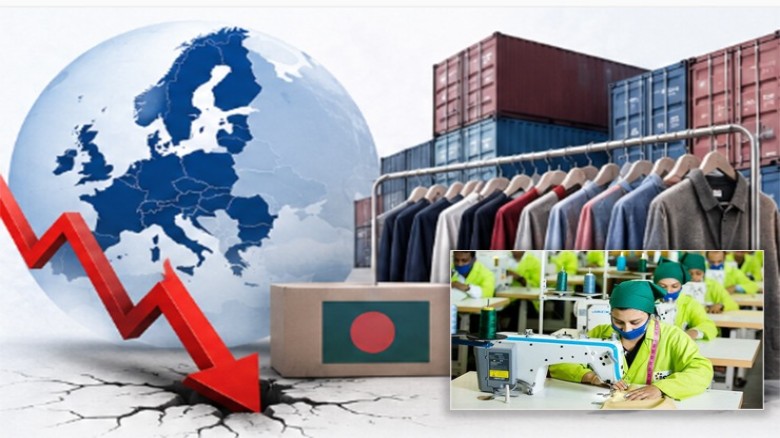
Bangladesh's garment fortress is breaking in Europe, will it survive the crisis in new markets
The prolonged uncertainty in the global market, the economic slowdown in Europe, inflationary pressures and consumer spending contraction have clearly affected Bangladesh's ready-made garment (RMG) exports. In the 2025-26 fiscal year, the country's garment exports decreased by 1.64 percent compared to the previous fiscal year to 38.70 billion US dollars. In particular, the decline in exports to the country's largest export destination, the European Union (EU), has had a negative impact on overall export earnings.
However, despite this pressure, positive growth in some markets such as the United States, the United Kingdom, Canada, the Middle East and China indicates new prospects for Bangladesh's export sector. Sector stakeholders say that it will be difficult to survive in the global competition in the future without reducing over-reliance on traditional markets and strengthening its position in new markets and emphasizing the production of high-value garments.
These figures have emerged from the latest data analysis by the Export Promotion Bureau (EPB).
Big blow to exports to the EU
The European Union is still the largest destination for Bangladesh's garment exports. However, exports to this market fell by 3.31 percent to US$19.06 billion in the 2025-26 fiscal year. As a result, the EU's share in total garment exports has also decreased to 49.25 percent, which was 50.10 percent in the previous fiscal year.
According to economists, economic growth in various European countries has been weak for a long time, inflation is relatively high, and consumers have reduced unnecessary clothing purchases. As a result, international brands have also taken a cautious stance in placing new purchase orders. This has directly affected the Bangladeshi garment industry.
Added to this is the long-standing uncertainty about whether Bangladesh will continue to enjoy tariff benefits in the European market after its transition from a least developed country (LDC). Although the LDC transition period has been extended for another three years, concerns about the future trade structure have not completely disappeared.
Germany's biggest decline
Germany is Bangladesh's largest market among EU countries. But in the current fiscal year, exports to the country fell by 11.50 percent to $4.38 billion, from about $4.95 billion the previous year. Product-wise, knitwear exports to Germany fell by 12.65 percent and woven apparel exports fell by 9.63 percent.
Not only Germany, exports to France fell by 8.74 percent and Italy by 7.78 percent during the same period. As a result, Bangladesh's exports are on a downward trend in almost all major European markets.
According to analysts, new orders have not increased at the expected rate due to high interest rates in Europe, a crisis in consumer confidence and excess inventory at retailers.
Positive growth in the US, UK and Canada
Despite the decline in exports to Europe, there is some good news for Bangladesh from North America and the UK. As a single country, the US continues to be Bangladesh's largest apparel export market. Exports to the country increased by 2.63 percent to $7.74 billion in the fiscal year under review. The US's share in total exports also increased to 20.01 percent.
Exports to the UK increased to $4.39 billion. The country's growth rate was 0.91 percent. In addition, exports to Canada increased by 3.20 percent to $1.34 billion.
Taken together, the US, UK and Canada now account for more than 35 percent of Bangladesh's total apparel exports—which has helped partially offset the loss of exports to the European Union market.
Mixed picture in non-traditional markets
Overall, the expected results in non-traditional markets have not been achieved. Exports to these markets fell by 4.25 percent to $6.16 billion. The share of these markets in total exports also fell to 15.93 percent, from 16.36 percent the previous year. However, the situation is not the same in all markets.
Exports to the Middle Eastern country of Saudi Arabia increased by 18.97 percent. In particular, woven garment exports grew by about 29 percent. Exports to the United Arab Emirates increased by 16.23 percent. Exports to China increased by 17.12 percent, reaching $263 million.
According to analysts, new opportunities are being created for Bangladesh as production costs in China increase, labor costs increase and the country's domestic market becomes more dependent on imports. Similarly, the rapidly expanding retail market in the Middle East is also becoming a potential for Bangladeshi exporters.
More pressure on knitwear
A product-wise analysis shows that knitwear exports have declined by 2.53 percent. On the other hand, woven garment exports have declined comparatively less—only 0.61 percent. This means that the woven garment sector has shown relatively good stability in the current fiscal year, while knitwear has come under more pressure.
Concerns over LDC transition and FTA
BGMEA President Mahmud Hasan Khan Babu told Bangla Tribune, “There is still uncertainty among entrepreneurs about the possible free trade agreement (FTA) with the European Union and post-LDC trade benefits. At the same time, competing countries like India have made significant progress in expanding trade benefits with the European Union and the United Kingdom. As a result, competition in the international market is becoming more difficult.”
However, he believes that extending the LDC transition deadline by another three years has created an opportunity for the government and businessmen to make necessary preparations. If effective trade diplomacy, new market expansion, and necessary policy reforms can be implemented within this period, Bangladesh's export sector
© All rights reserved: Daily Phultala Protidin
 Print
 Save